In this blog: A campaign goes viral when the audience, not the ad budget, rapidly and organically shares the content. ...

Since we initially wrote this in February 2026, ChatGPT’s ad landscape has opened from a closed beta to welcome a broader swath of companies. We’ve updated information throughout to reflect matters as they currently stand.
Here’s the long and short of it: OpenAI has added a self-service ads platform that, as of the time of writing, is in beta for US advertisers. With this, companies of all sizes can create, manage and measure their ChatGPT ads in one space. Purchased ads will appear directly in relevant ChatGPT prompts.
They’re also introducing cost-per-click bidding and expanding measurement tools through the Ads Manager. Though it does not appear to be open to all businesses just yet, OpenAI has indicated they’re expanding access. You can sign up for an account and learn more here.
For a while, ChatGPT felt like the only place in the digital world that didn’t push banner ads or sponsored links. A rare space that focused solely on providing answers and value.
Of course, as is always the case with something this uniquely valuable, it was only a matter of time before monetization entered the conversation. As ChatGPT’s adoption accelerated, so did discussions about how to scale, sustain, and eventually capitalize on its momentum by incorporating ads.
Now, as of early May, ads in ChatGPT are becoming a reality for free and ChatGPT Go users.
For brands and marketers, this moment isn’t simply about hype. This is a signal of a much greater shift happening in how we think about discovery and how to capitalize on it to drive positive business outcomes, rather than sticking with familiar search avenues.
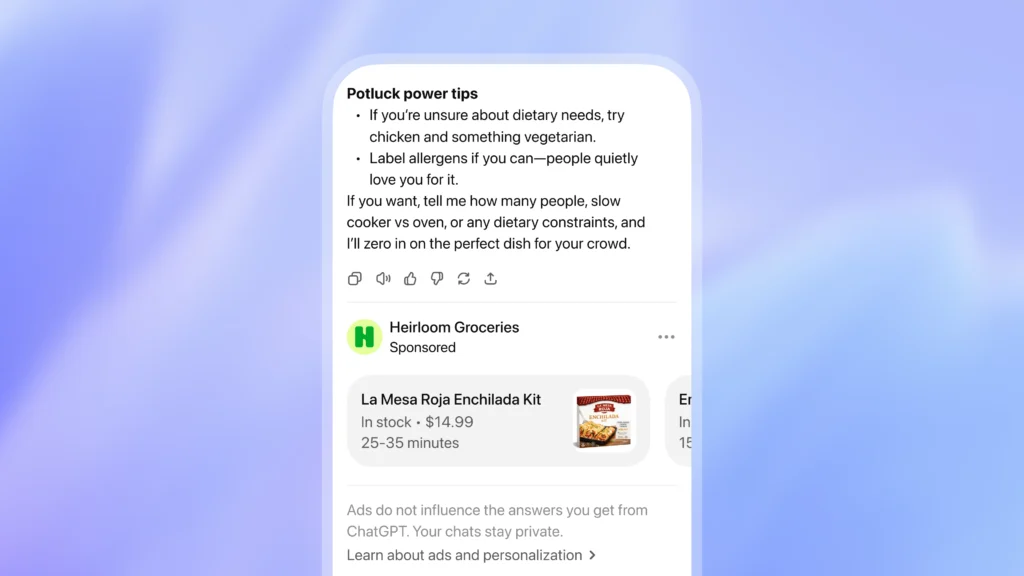
Ad example and image from OpenAI
ChatGPT’s adoption curve has been nothing short of historic. In less than two years, it’s gone from a research demo to a daily utility for hundreds of millions of people. It’s helping users write, plan, learn, troubleshoot, compare and decide faster than traditional search ever could.
Zoom out and you’ll see that this rise isn’t happening in a vacuum. Governments and enterprises alike are pouring unprecedented investment into AI infrastructure. AI isn’t a trend; it’s cementing its status as a layer in modern work and decision-making.
Though ChatGPT has been established as the LLM of choice for many, OpenAI has been clear about how expensive it is to run AI at a global scale. Subscriptions help, but they don’t unlock access for everyone. Advertising, when done carefully, becomes a way to fund growth while keeping powerful tools broadly available.
In other words, ads aren’t the product. They are a revenue stream that lives within it.
Back in February, OpenAI quietly started testing a closed beta for ads inside ChatGPT. The first invitations were extended to major players in the advertising space, like Omnicom, WPP and Dentsu. This pilot was positioned as premium inventory, with CPMs reported around $60 and a minimum buy of roughly $200,000. This signals that the early rollout was aimed at brand experiments rather than performance-driven campaigns.
As of May 2026, this beta program for ads has expanded, with a self-serve ads manager aimed at making ad creation, management and measurement possible for businesses of all sizes.
You’ll soon start to see ads for companies like Adobe, Audible and Ford pop up within ChatGPT, depending on your conversations with the platform. You won’t need to worry about ads in the middle of ChatGPT’s responses, either. They will be clearly labeled so that they’re immediately distinguishable from your conversation.
If your mental image of “ChatGPT ads” looks like a cluttered SERP from 2012, it’s worth resetting expectations because OpenAI has been deliberate in how it’s framed monetization.
Early reporting suggests a model that’s far more contextual than traditional paid search. OpenAI says that ads will not influence ChatGPT responses. You’ll see ads when they are deemed relevant and valuable to the user. The company has also said that ads will become more targeted based on engagement, and that past chats with ChatGPT can influence the content of the ads shown.
ChatGPT users will be able to dismiss ads, share feedback, delete ad data and even opt out of personalized advertising, though it’s currently unclear whether that’s for all users, or just paid ones.
Since ChatGPT is built on trust and value, this user-focused approach is critical to the success of in-chat advertising. The moment users feel the system is optimizing for advertisers over answers, their perception of the value exchange breaks. OpenAI knows that, and advertisers should too.
Remember: this isn’t Google Search circa 2005. ChatGPT is a task-easing, decision-making engine that guides users through research and purchase journeys that are fully unique and tailored to their needs.
It’s tempting to treat ChatGPT ads as a seismic shift. In reality, they’re an acceleration of trends already well underway.
Traditional paid search has been evolving quietly for years. Google and Bing have both been experimenting with:
The direction is clear: the future of paid media is more integrated.
As AI increasingly mediates how results are surfaced, ads have to earn their place by being genuinely relevant. The old playbook (outbid competitors, dominate the page and worry about quality later) doesn’t hold up in AI-driven environments.
Despite the headlines, people haven’t abandoned Google. They’ve added new tools to their process. Today’s user journey is often parallel:
But at the same time, despite overall search behavior continuing to increase, we are seeing:
This creates both ambiguity and opportunity. Visibility no longer guarantees traffic. Authority, structure and data quality matter more than ever. Being “findable” now means being noticeable to machines as much as humans. Search is becoming multi-surface, not disappearing.
At TriMark, we’re less interested in the novelty of ChatGPT ads than in what they reveal about the future of performance marketing.
A few things we’re paying attention to:
Treat this new ad placement as a new decision avenue where context matters as much as the query. Brands will be evaluated continuously, not just at the moment of a click.
None of this means the fundamentals are obsolete. Paid search still works, SEO still matters and an integrated strategy still beats standalone tactics. That being said, the playbook is expanding.
TriMark is building on what works while preparing for what’s next:
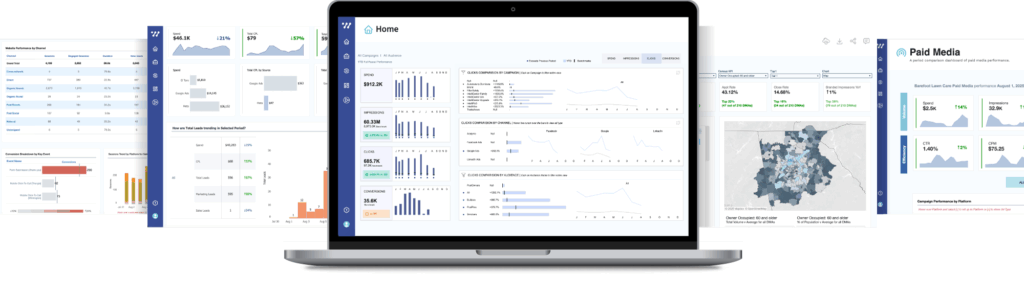
Our proprietary data platform, Waves, is a big part of how we measure and share performance insights. It helps us unify signals across paid media, organic performance and emerging AI surfaces so we can understand what’s actually driving outcomes, not just clicks.
This is how we help brands stay ahead of change: not by chasing every new feature, but by integrating innovation into a cohesive strategy.
Discovery is becoming conversational. Decisions are becoming contextual. And performance is becoming harder to fake.
Ads in ChatGPT are a milestone, but not because they change everything overnight. Instead, they confirm where search has gone and is headed in the future.
Discovery is becoming conversational. Decisions are becoming contextual. And performance is becoming harder to fake.
The brands that win in this next era won’t be the ones that simply show up everywhere. They’ll be the ones that show up with the right data, the right message and the right understanding of intent. Yes, marketing and monetization will inevitably push the limits, but for teams that embrace change thoughtfully, this moment represents something better than disruption. It’s all about the opportunity.
Bottom line: there won’t be any awards here just for trying new things. Knowing where your users’ decision-making and buyer journeys are in 2026 and meeting them there at the right moment of intent will be transformative.
In part 2 of this exploration into ChatGPT ads, we’ll talk about how we expect it to play a role in our strategies and how we’ll measure its success.
CONTACT US
We don’t do one-size-fits-all. We build custom strategies that solve real business problems and drive results you can measure. Let’s talk about how we can grow your brand—starting today.
"*" indicates required fields